How to Draw Faster and Better Without Losing Quality
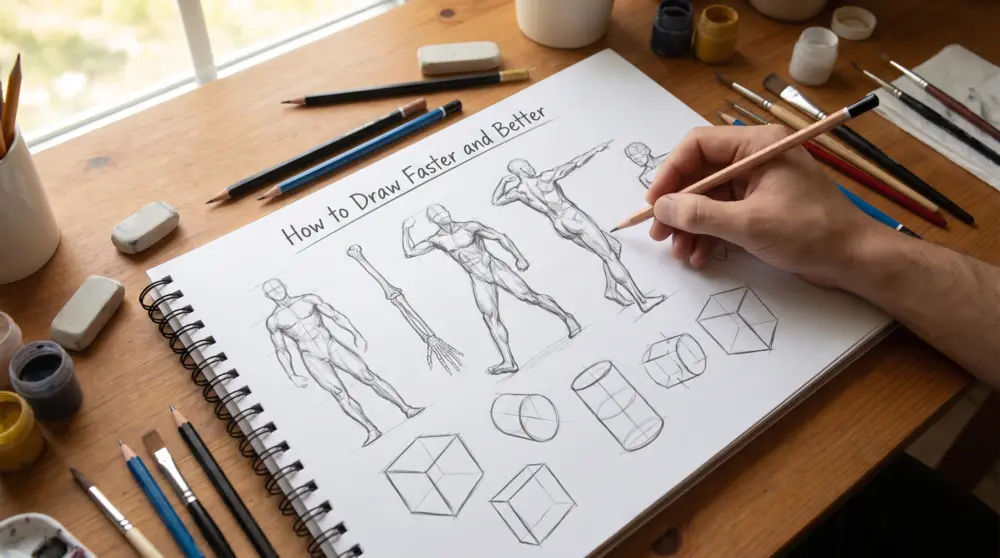
Here’s something most drawing tutorials won’t tell you: the artists who draw fastest aren’t rushing. They’re just making fewer unnecessary decisions. Speed in drawing isn’t about moving your hand faster. It’s about not wasting time on things that don’t matter yet — details before structure, shading before proportion, rendering before composition. Once you eliminate those habits, drawing gets faster almost automatically.
Why Most Artists Draw Slowly (And Don’t Realize It)
Before fixing your speed, it helps to understand what’s actually slowing you down. Most of the time, it’s not a lack of talent — it’s a handful of habits that compound over every drawing session.
Focusing on Details Too Early
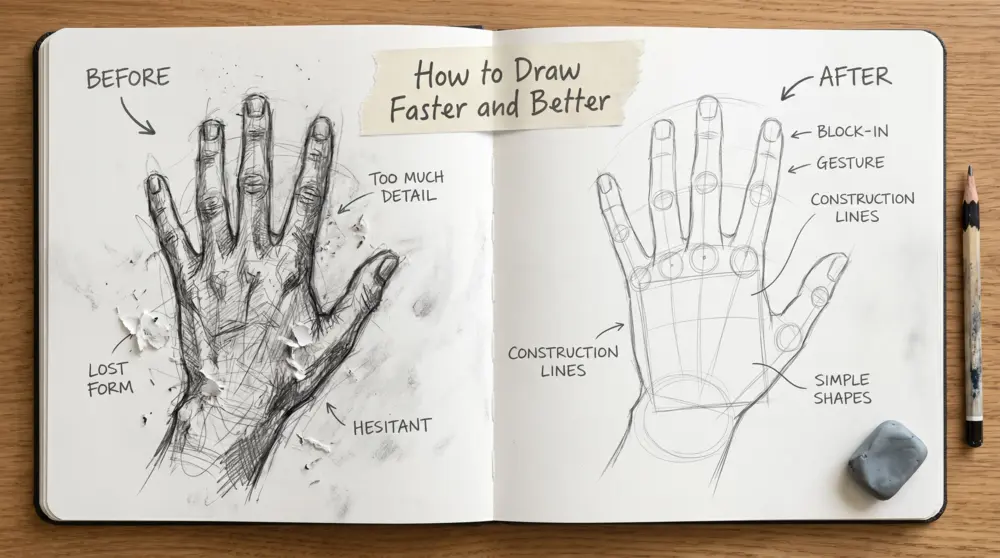
This is the most common mistake, and it affects beginners and experienced artists equally. You start drawing a face and immediately zoom into the eyelashes — before the head shape is even correct. You shade clothing folds before checking whether the figure’s proportions make sense. The problem isn’t the detail itself. It’s the timing. Details added over a flawed structure just hide the problem rather than fix it. And when you eventually notice the proportions are off, you’ve wasted all that rendering time.
Perfectionism makes this worse. Many artists erase and redraw the same line four or five times during the rough sketch phase, trying to get it perfect before moving on. That habit destroys rhythm and momentum — two things that make drawing feel effortless when you have them.
Weak Drawing Fundamentals
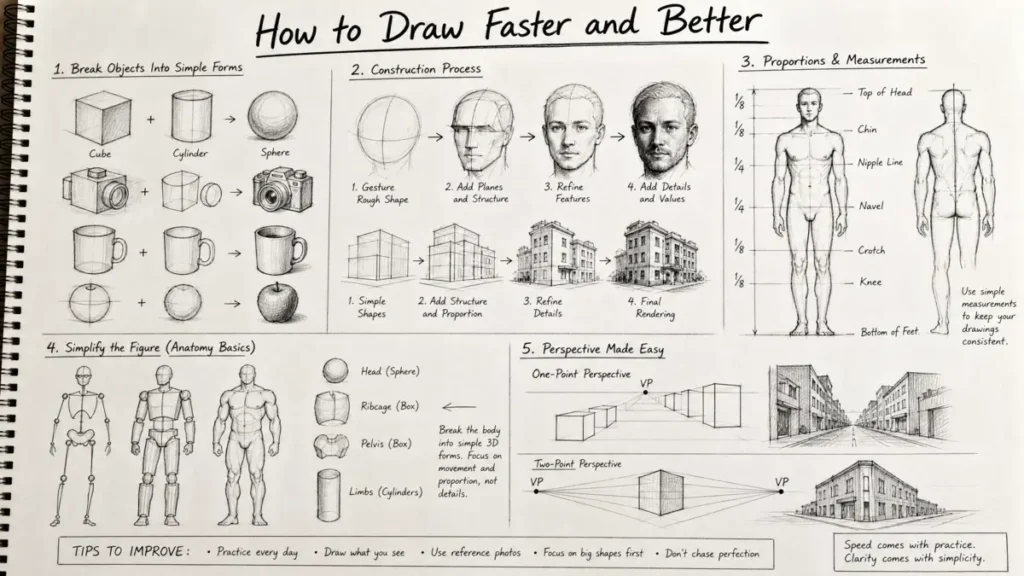
If you can’t simplify what you’re looking at, you’ll always draw slowly. Strong artists break complex subjects into basic forms — cubes, cylinders, spheres — before worrying about anything else. If that skill isn’t in place, every drawing becomes a problem-solving session from scratch. Weak perspective and anatomy knowledge compound the issue. When you don’t understand how the body is structured, a simple seated figure becomes a guessing game. You draw, erase, redraw, erase again — not because you’re being careful, but because you don’t have a reliable system to fall back on.
Hesitant Linework
Short, scratchy strokes — often called “chicken scratching” — are one of the biggest time-wasters in drawing. Instead of committing to a line, artists make dozens of tiny overlapping marks hoping they’ll add up to the right shape. They rarely do, and cleaning up afterward takes longer than just drawing confidently in the first place. Professional artists draw from the shoulder, not just the wrist. Larger arm movements produce smoother, longer lines that communicate form clearly — and they do it faster.
No Structured Practice System
Drawing a portrait one day, random doodles the next, and a landscape the week after that isn’t practice — it’s entertainment. There’s nothing wrong with drawing for fun, but it won’t build the specific skills that make you faster. Deliberate practice targets one skill at a time. Timed gesture drawing for movement. Line drills for pencil control. Shape breakdown exercises for visual simplification. Each session has a purpose, and that purpose compounds over time.
The Real Secret Behind Fast, Skilled Drawing
Fast drawing comes down to three things: simplification, prioritization, and muscle memory. None of them require talent. All of them develop through practice.
Simplification means reducing what you see to its essential forms before drawing anything. A face isn’t a collection of features — it’s a sphere with planes, landmarks, and proportional relationships. A figure isn’t anatomy — it’s a gesture line with cylinders attached. Artists who simplify well draw more efficiently because they’re working with a clear plan instead of guessing as they go.
Prioritization means understanding that not every part of a drawing deserves equal attention. The 80/20 rule applies here: a small number of details — usually the focal point and the largest structural elements — create most of the visual impact. Background areas, secondary objects, and supporting textures can stay loose. Strong artists know when to stop refining.
Muscle memory reduces how much mental effort each stroke requires. After drawing enough hands, you stop analyzing every finger and start placing shapes from memory. After enough gesture sessions, your hand starts capturing movement before your brain fully processes what it’s doing. That automatic quality is what makes professional drawing look effortless — and it only comes from repetition.
Techniques That Actually Improve Drawing Speed
Start Every Session With Gesture Drawing
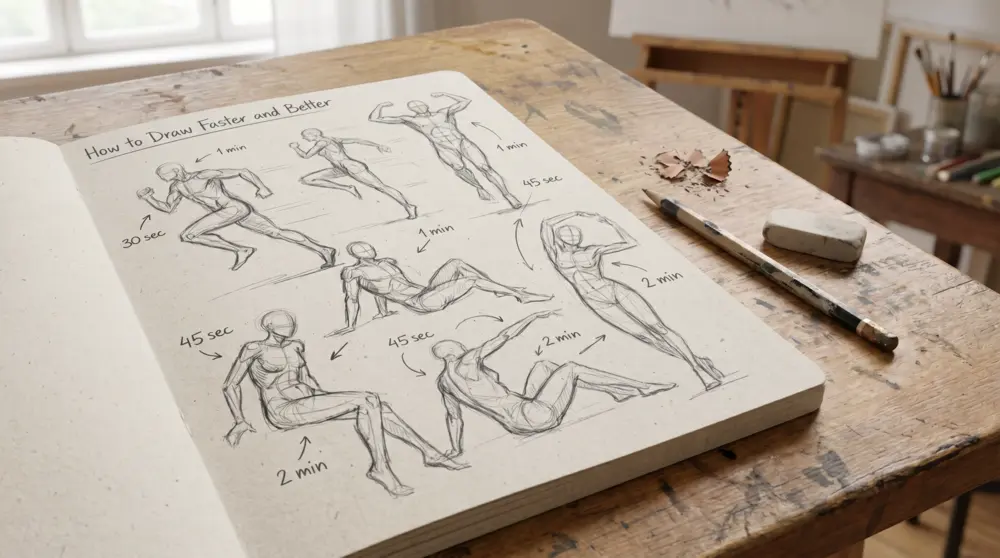
Gesture drawing is the single most effective warm-up for faster sketching. The goal isn’t a finished drawing — it’s capturing movement, energy, and balance as quickly as possible. Start with 30-second poses. Focus entirely on the flow of the body: the curve of the spine, the weight shift in the hips, the direction of the arms. Ignore clothing, facial features, and texture entirely. Regular gesture practice trains your eye to find the essential information in any reference and your hand to put it down quickly. Over time, that skill transfers into everything else you draw.
Draw From Your Shoulder
If you’re drawing with only your wrist, you’re limiting your line length and forcing more strokes to cover the same distance. Practice drawing long lines and large curves using your whole arm — elbow and shoulder driving the motion, wrist staying relatively loose. It feels awkward at first. Do it anyway. Large arm movements produce the kind of smooth, confident lines that make drawings look professional, and they cover ground faster than scratchy wrist-only strokes.
Work From Large to Small — Always
Build the full structure before touching any detail. For a figure: gesture line first, then major masses (head, ribcage, hips), then limbs, then hands and feet, then facial features, then clothing, then texture. Each stage should be complete before moving to the next. This process feels slower at first because it requires discipline. But it eliminates the most time-consuming part of drawing — going back to fix structural problems after you’ve already rendered on top of them.
Use Time Limits
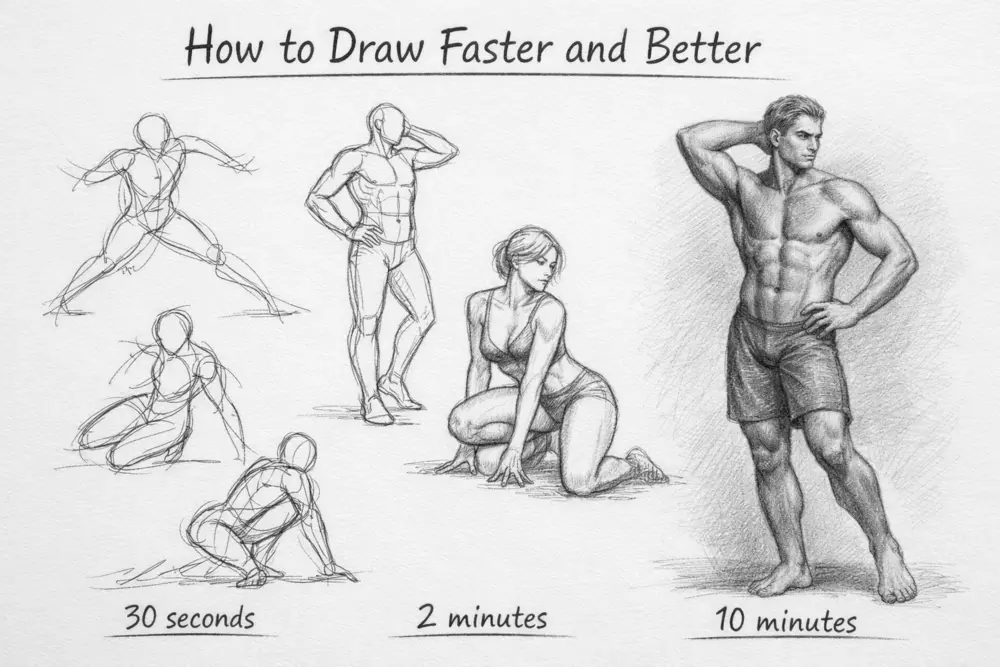
Timed sketching forces faster decision-making and breaks the overthinking habit. A practical progression:
- 30 seconds: Movement and gesture only. One curved line for the spine, basic masses. Nothing else.
- 2 minutes: Add structure. Proportion checks, limb placement, head size relative to body.
- 5–10 minutes: Controlled refinement. Clean the most important lines, add the key shadows, stop.
The point isn’t to finish a polished drawing in 30 seconds. The point is to train your brain to identify what matters first — and that habit carries over into longer drawings automatically.
Learn to Compare Proportions Quickly
Fast artists don’t guess measurements — they compare. How wide is the head relative to the shoulders? How long is the torso compared to the legs? Is the elbow at waist height or hip height?
These comparisons take seconds and prevent the kind of proportion errors that cost minutes to fix. Get in the habit of making two or three quick checks before committing to any major shape, and you’ll catch mistakes before they become embedded in the drawing.
Daily Exercises That Build Drawing Speed
Consistency beats intensity. Thirty focused minutes every day will improve your speed faster than a three-hour session once a week. Here are the exercises worth including in a regular rotation:
30-second gesture sketches — Do at least 20 per session. Focus purely on movement and energy. Posemaniacs, Line of Action, and SenshiStock are all good free resources for reference poses.
Line confidence drills — Draw long straight lines without sketching. Then ellipses. Then flowing curves. The goal is a single clean stroke from point A to point B. This trains the arm movement and commitment needed for confident linework.
Shape breakdown training — Pick any object — a chair, a shoe, a coffee mug — and reduce it to its basic geometric forms. A mug is a cylinder with a handle. A chair is boxes and cylinders in specific proportions. This exercise directly improves how quickly you can plan a drawing before starting.
Visual memory sketches — Study a reference image for 60 seconds, then put it away and draw from memory. Compare afterward. This is one of the most effective exercises for building the visual library that lets professional artists draw quickly without constant reference checking.
Timed object sketching — Set a 5-minute timer and sketch a household object from observation. The time limit prevents overworking and trains you to identify the most important information quickly.
How Professional Artists Draw So Fast
When you watch a skilled artist work, the speed can look almost supernatural. What’s actually happening is more mundane: they’ve automated a large portion of the process through repetition, and they’re making very deliberate choices about where to spend effort. Professional artists suggest detail rather than copying it. Hair becomes a few grouped shapes with implied texture. Clothing folds begin as major directional lines. Background objects stay loose and impressionistic. The viewer’s brain fills in the rest — and the drawing reads as complete even though less than half of the detail is actually there.
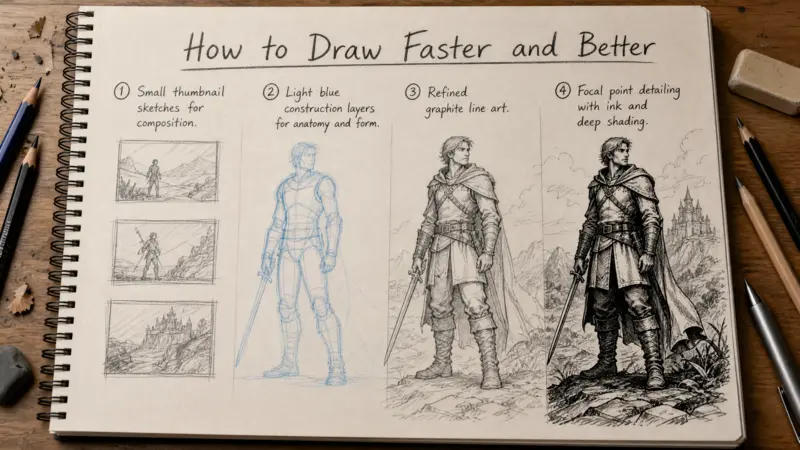
They also follow organized workflows. Most professional illustration starts with small thumbnail sketches to test composition. Construction layers come next — simple shapes, guide lines, major masses. Refinement happens last, and it’s targeted: focal areas get detailed attention, supporting areas stay loose. This layered process almost completely eliminates the major corrections that eat up time in unstructured drawing. And they know when to stop. Over-rendering is one of the most common ways artists waste time. Adding more texture to a background that’s already reading correctly, darkening a shadow that’s already defining the form — these decisions don’t improve the drawing, they just extend the session. Strong artists have a clear sense of when a drawing is done, and they stop there.
The Psychology Behind Slow Drawing
Technique matters, but mindset creates more problems than most artists realize.
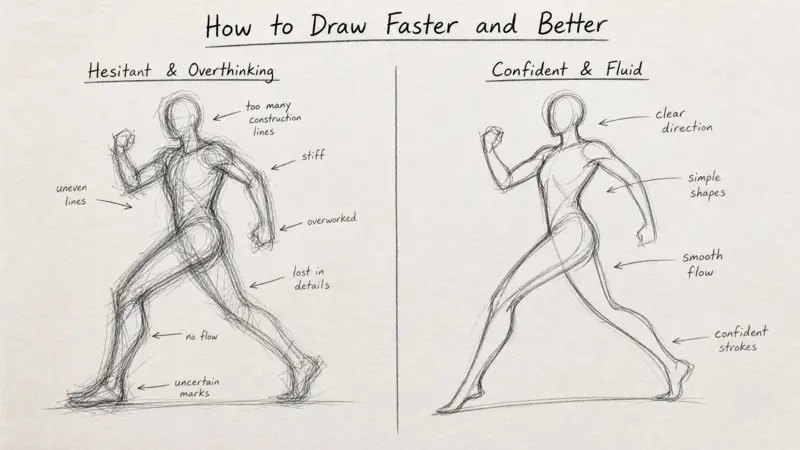
Perfectionism is the biggest one. It shows up as constant erasing during rough sketch stages, redrawing the same line six times because it’s slightly off, refusing to move forward until one area is “right.” The irony is that perfectionism during construction usually produces worse drawings — the rhythm breaks down, the lines get tighter and more hesitant, and the structural problems that were present from the start never get addressed because you kept getting stuck on surface details.
The fix is intentional imperfection during early stages. Rough construction sketches are supposed to look rough. Let them. Fix structure first, polish later.
Overthinking creates a different problem. When you analyze every mark before making it, drawing becomes mentally exhausting — and the resulting strokes are tentative and stiff. Timed sketching is one of the most effective treatments for this because it physically prevents overthinking. When you have 30 seconds, you draw. You don’t plan.
Fear of bad drawings keeps many artists from doing the high-volume, messy practice that actually builds skill. Polished finished pieces are fine, but they rarely push your fundamentals. It’s the quick, ugly, exploratory sketches — the ones you’d never post online — that teach the most. Volume matters during skill-building. Twenty rough gesture sketches teach more than one carefully rendered portrait.
Traditional vs. Digital: Which Is Faster?
Both can be fast. Speed depends on workflow, not medium. Digital tools do offer real advantages for correction-heavy work. Layers allow you to separate construction from final linework, making it easy to clean up without starting over. Undo is obviously helpful. Brush stabilization can smooth out hesitant linework. These features genuinely save time during the refinement stages.
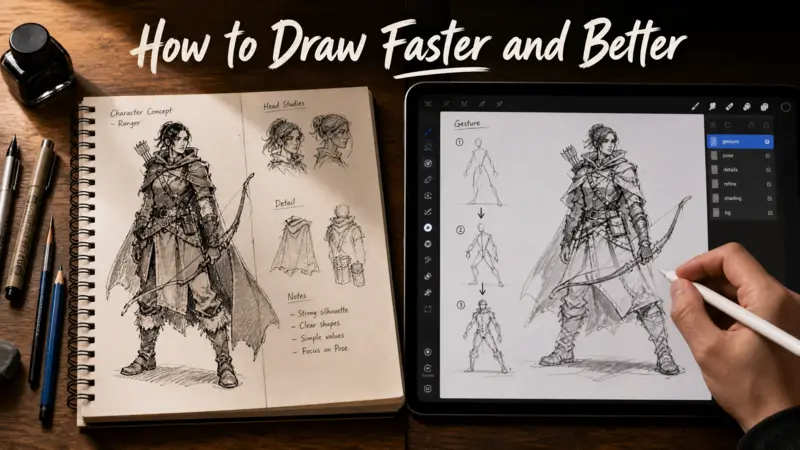
But digital habits can also slow artists down. Excessive zooming is one of the most common: when you work at 400% zoom on a 2-inch section of the drawing, you lose all sense of overall proportion and composition. Many artists also spend too long switching brushes or adjusting settings instead of drawing. And the unlimited undo capability can actually make perfectionism worse — when there’s no cost to erasing, artists erase more.
Traditional drawing, particularly ink work, forces commitment. You can’t undo a pen stroke, so you plan more carefully and draw more deliberately. Many artists who struggle with hesitant linework find that spending time with ink — even just for warm-up exercises — noticeably improves their confidence when they return to pencil or digital.
30-Day Plan to Draw Faster
Practice 30–45 minutes daily. Save your sketches each week so you can compare progress.
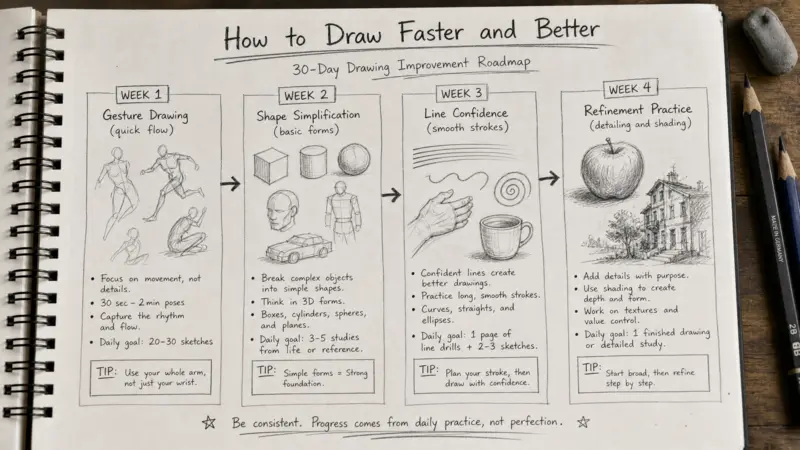
Week 1 — Observation and Gesture The goal is building your eye, not producing polished work. Do at least 20 gesture sketches per day at 30 seconds to 1 minute each. Spend the rest of the time drawing simple objects from observation — mugs, shoes, books, anything nearby. Focus entirely on movement, balance, and large shape relationships. No shading, no detail.
By the end of week one, you should notice faster shape recognition and less hesitation at the start of a sketch.
Week 2 — Shape Simplification Spend the week breaking everything into basic forms. Cubes, cylinders, spheres. Turn your hand into boxes and cylinders. Reduce faces to spheres with plane indications. Draw anatomy using simplified body forms rather than realistic muscle detail. Every subject you encounter this week gets reduced to its construction shapes first.
The checkpoint here is proportion control — your sketches should be getting structurally cleaner even at rough stages.
Week 3 — Speed and Line Confidence Increase pace with timed exercises: 30-second, 2-minute, and 5-minute studies in every session. Add arm-movement line drills to your warm-up. Draw long lines, ellipses, and flowing curves without scratching. Draw from the shoulder.
Gesture drawing continues — it sharpens fast observation and trains the decisive strokes that make work look professional.
Week 4 — Controlled Refinement Now apply everything: start loose, build structure, refine strategically. Practice 10-minute refinement drills where you start with a rough construction sketch and bring it to a finished state without overworking it. Focus detailing on the focal point. Keep supporting areas loose.
Compare your week four sketches to week one. Look for cleaner construction, more confident lines, and fewer correction marks.
Common Mistakes That Keep Artists Slow
Drawing tiny details first. If the structure isn’t right, no amount of detail will fix it — and you’ll have to redo the detail anyway.
Short scratchy lines. Every time you make five small strokes where one confident stroke would do, you’re spending four extra marks and making the line worse. Commit to longer strokes.
Practicing without a goal. Random drawing is relaxing, but it doesn’t build specific skills. Each session should have a clear focus.
Copying outlines instead of studying structure. Tracing or outline-copying tells you what something looks like. Understanding construction tells you why — and that knowledge transfers to new subjects.
Comparing yourself to professionals. Professional artists have years of repetition behind their speed. Comparing your month-one work to their published illustrations is like comparing a beginner runner to a marathon athlete. Track your own progress instead.
Spending too long on one drawing. Long sessions often produce diminishing returns. After a certain point, you’re no longer improving the drawing — you’re just changing it. Timed studies teach you to recognize when a drawing is done.
How Long Does It Take?
Most artists notice meaningful improvement in speed within three to six weeks of consistent, structured practice. That’s not a dramatic transformation — it’s incremental changes that compound. Gesture sketches start feeling more natural. Construction goes down faster. You spend less time correcting and more time drawing.
The early signs of improvement usually show up in this order: faster shape recognition first, then cleaner construction sketches, then more confident linework, then less time spent on corrections overall. If you’re tracking your work weekly, you’ll see these changes clearly in comparison. What doesn’t work is inconsistency. A few intense practice sessions followed by a week off resets more progress than most artists realize. Thirty minutes every day will beat three hours every weekend, almost without exception.
FAQ
How can I draw faster without losing quality?
Work from large shapes to small details, use timed gesture practice regularly, and stop adding detail before your structure is correct. Speed and quality improve together when the workflow is right.
Why do professional artists draw so quickly?
They’ve automated a large portion of the process through repetition, and they follow efficient workflows — thumbnailing, construction, then targeted refinement. They also simplify aggressively and know when to stop.
What exercises improve drawing speed the most?
Gesture drawing, timed studies, and line confidence drills are the highest-return exercises. Shape breakdown training is also essential for reducing hesitation at the planning stage.
Does gesture drawing actually help?
Yes — consistently. It trains faster observation, improves movement recognition, and builds the decisive stroke habits that make all your drawing faster, not just gestures.
How often should I practice?
Daily, for 30–45 minutes. Short, focused, consistent sessions outperform occasional long ones significantly.
Why do I spend too long on one drawing?
Usually because you’re adding detail before structure is resolved, or because you’re trying to fix a fundamental problem with surface-level rendering. Timed studies help break this habit.
Is digital drawing faster than traditional?
It depends on the stage. Digital is faster for corrections and refinement. Traditional exercises — especially ink work — often build line confidence and planning skills faster.
How long does it take to improve drawing speed?
Most artists see noticeable changes within three to six weeks of consistent, structured practice. Progress is gradual but measurable.
Final Thoughts About ( How to Draw Faster and Better )
Drawing faster and drawing better aren’t separate goals — they reinforce each other. When your fundamentals are strong, decisions come quickly. When your workflow is clear, you stop wasting time. When your lines are confident, you stop correcting and start building. The artists who draw quickly aren’t working harder than everyone else. They’re working with less friction — fewer hesitations, fewer corrections, fewer detours into detail before structure is ready. That kind of fluency develops through repetition and smart practice, not through rushing. Start with gesture drawing. Build your shape vocabulary. Use time limits. Draw from the shoulder. Track your progress weekly. The speed will follow.