Drawing Mistakes Beginners Make and How to Fix Them
Most beginners struggle with the same drawing mistakes. These problems appear in sketches, portraits, characters, and realistic drawings. A drawing may look flat, stiff, or unbalanced. Small errors often create bigger visual problems. Many artists blame talent first. The real issue usually comes from weak fundamentals. Bad proportions can distort the entire sketch. Poor shading removes depth and realism. Weak line confidence makes drawings look messy. Perspective mistakes can break object structure. Many beginners draw details too early. That habit hides larger anatomy and proportion errors. Observation skills also matter. Artists often draw symbols instead of real shapes. For example, beginners draw “eye symbols” instead of actual eye forms. That creates unrealistic facial features.
Drawing mistakes also repeat in digital art. Traditional and digital artists face similar problems. Most improvement starts with better visual analysis. Artists need to understand why drawings look wrong. Simple fixes often solve major drawing problems. Clear structure improves sketch accuracy quickly. Construction lines help organize shapes and proportions. Gesture drawing improves movement and pose flow. Understanding light direction improves shading quality. Strong contrast adds depth to flat drawings.
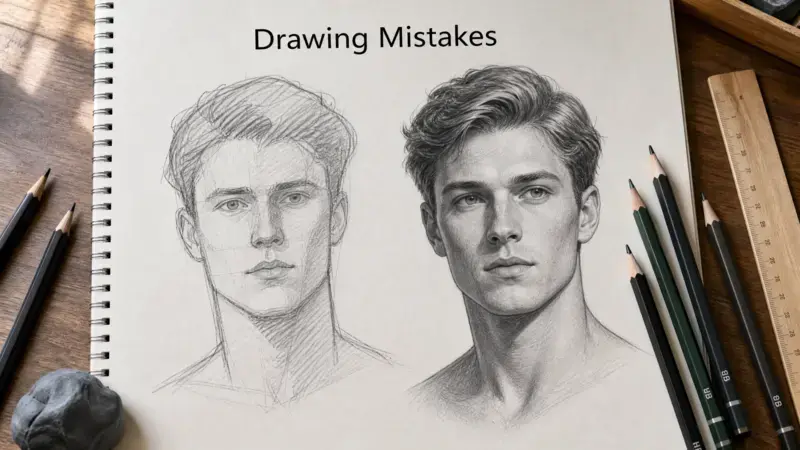
Artists improve faster when they identify recurring mistakes. Random practice rarely fixes core weaknesses. A self-diagnosis system helps artists review their work clearly. It turns confusing mistakes into specific problems. This guide focuses on practical drawing corrections. Each section explains what causes common art mistakes. You will also learn how to spot errors early. That skill prevents frustration during longer drawings. The goal is not perfect artwork immediately. The goal is stronger drawing fundamentals and cleaner visual decisions. Many professional artists still study basic forms daily. Simple exercises build reliable drawing accuracy over time. The next sections break down the most common drawing mistakes. Each mistake includes direct fixes and useful practice methods.
Why Most Drawings Look Wrong at First
Drawing Is a Skill, Not Talent
Most beginners face similar drawing mistakes early. The problem usually comes from limited visual training. Drawing depends on observation skills. Artists must study shapes, angles, lighting, and proportions carefully. Many beginners draw from memory too quickly. Memory often changes important visual details. For example, people think they understand eyes well. Real eye anatomy looks more complex on paper. Observation drawing trains visual accuracy. It helps artists notice spacing, structure, and perspective. Imagination also matters in art. Strong imagination still needs solid drawing fundamentals. Experienced artists still make sketching mistakes sometimes. Complex poses and lighting create new challenges.
Professional artists often correct anatomy and shading repeatedly. Clean artwork usually comes after several adjustments. Bad drawing habits also slow progress. Messy linework and rushed sketching create weak structure. Many beginners compare finished art with rough practice sketches. That comparison creates unrealistic expectations. Strong drawings rely on simple foundations first. Artists build forms before adding details. Shapes, proportions, and perspective guide the entire artwork. Small mistakes in structure affect everything later. Learning art takes repeated visual analysis. Artists improve faster when they study their mistakes carefully.
The Hidden Problem Behind Most Drawing Mistakes
Most drawing mistakes start before shading or details. The real problem begins during the early sketch stage. Many beginners rush into outlines immediately. They skip gesture drawing and construction lines. That creates inaccurate anatomy and weak proportions. Characters may look stiff or unbalanced. Some artists focus on details too early. They draw eyelashes before fixing head structure. This habit causes larger drawing errors later. Correcting details becomes harder afterward. Another common problem involves symbol drawing. Beginners draw symbols instead of real observations. For example, they draw a simple “cloud shape” for hair. Real hair follows volume, direction, and light.
The same issue affects hands and facial features. Artists simplify forms too much from memory. Poor planning also damages composition. Objects may float or tilt unnaturally. Perspective mistakes often come from weak structure. Artists ignore horizon lines and vanishing points. Flat shading creates another major issue. Many beginners use the same pencil pressure everywhere. That removes contrast and depth. Objects lose realistic form quickly. Weak line confidence also hurts sketch quality. Short scratchy lines make drawings look uncertain. Artists improve faster when they slow down early. Clear construction prevents many common art mistakes.
How This Guide Will Help You Improve Faster
This guide breaks down common drawing mistakes clearly. Each section focuses on one major problem. You will learn why mistakes happen first. Understanding the cause makes correction easier. You will also learn practical drawing fixes. Each method focuses on simple visual improvement. The guide covers proportions, perspective, shading, and anatomy. It also explains line control and gesture drawing. You will learn how to analyze your own artwork. That skill improves observation and drawing accuracy. Self-correction matters in every art style. Artists need clear ways to review mistakes.
This guide also explains common beginner drawing habits. Some habits quietly damage progress over time. Simple exercises will help strengthen weak areas. Focused practice creates better visual understanding. You will also learn how professional artists approach structure. Most strong drawings begin with simple forms. The goal involves clearer thinking during sketching. Artists need strong decisions before adding details. Drawing mistakes become easier to fix with proper analysis. Small corrections often improve the entire artwork.
Mistake #1 — Bad Proportions
Why Proportions Make Drawings Feel “Off”
Bad proportions create some of the most noticeable drawing mistakes. Even small errors can change the entire artwork. The human brain notices proportion problems very quickly. Faces and bodies look strange when spacing feels incorrect. A head may look too large for the body. Legs may appear shorter than the torso. Eyes often create proportion issues in portraits.
Many beginners place eyes too high on the face. Some artists draw noses too small or mouths too wide. These mistakes reduce facial balance. Body anatomy also depends on proportion control. Incorrect shoulder width can distort character structure. Hands and feet often look inconsistent in sketches. Artists may scale them too small accidentally. Perspective can also affect proportions. Objects closer to the viewer should appear larger. Flat drawings usually show weak size relationships. That problem removes depth and realism. Strong proportions improve visual balance immediately. They help characters and objects feel believable.

Signs Your Proportions Are Wrong
Many drawing mistakes show clear warning signs early. Artists should learn to spot them quickly. Eyes placed too high create unnatural faces. Eyes placed too low flatten facial structure. Uneven eye spacing also looks distracting. One eye may appear larger accidentally. Arms often become too short in figure drawings. Hands may stop above the correct position. Leg length problems also appear frequently. Short legs can make poses look stiff. Some artists draw oversized heads without noticing. Others make necks too thin or too long. Shoulders may look uneven during sketching.
That issue weakens body symmetry. Character poses can lose balance easily. Weight distribution may feel unrealistic. Objects may also show proportion errors. A chair beside a table might look oversized. Perspective mistakes often connect with sizing problems. Nearby objects should not match distant object sizes. Artists should flip drawings horizontally sometimes. That method reveals hidden proportion issues quickly.
How to Fix Proportion Problems
Artists need structure before adding details. Simple measuring methods improve drawing accuracy. Start with large shapes first. Avoid drawing eyelashes or textures immediately. Use light construction lines during sketching. These lines guide anatomy and spacing. Compare one shape against another constantly. Check height, width, and angle relationships. For portraits, measure eye spacing carefully. Most faces fit one eye width between both eyes. Use vertical and horizontal guide lines often. These lines improve symmetry and placement. Anchor points also help maintain structure. Mark shoulder width and hip position early.
Artists should simplify the body into basic forms. Boxes and cylinders improve visual balance. Gesture drawing also supports better proportions. It helps organize movement and body flow. Observation matters during every stage. Study reference shapes instead of memorized symbols. Check drawings from a distance sometimes. Large mistakes become easier to notice. Many artists rotate their canvas during sketching. That method reveals uneven anatomy quickly. Slow planning usually prevents major drawing mistakes. Good structure creates cleaner final artwork.
Beginner Exercise
A simple drill can improve proportions quickly. Use basic household objects for practice. Choose one object with clear shapes. A mug or small box works well. Draw the object using simple forms first. Focus only on height and width relationships. Do not add shading immediately. Check proportions before drawing details. Next, compare your sketch with the real object. Look for angle and size differences. Repeat the exercise three times daily. Use different viewing angles each session.
Another useful drill involves face guidelines. Draw simple heads using horizontal placement lines. Practice eye spacing and nose placement repeatedly. Keep sketches loose and light. Gesture drawing also strengthens body proportions. Try quick thirty-second figure sketches. These exercises train observation and visual accuracy. They also reduce common drawing mistakes over time.
Mistake #2 — Weak or Scratchy Line Confidence
Why Beginners Draw Hairy Lines
Weak line control creates common drawing mistakes. Sketches often look messy and uncertain because of it. Many beginners draw with short repeated strokes. These marks create scratchy or hairy lines. Fear causes this habit frequently. Artists worry about making incorrect marks. Some artists erase lines constantly during sketching. That slows the drawing process significantly. Drawing too slowly also weakens line quality. The hand loses natural movement and rhythm. Finger-only movement creates stiff lines sometimes. Small wrist motions limit smooth control.
Many beginners focus on perfection too early. That mindset interrupts natural sketch flow. Weak observation skills also affect line confidence. Artists hesitate when structure feels unclear. Poor planning creates uncertain marks. Without construction lines, artists guess proportions repeatedly. Hairy lines often hide anatomy problems. Artists may sketch over mistakes instead of correcting structure. Flat drawings also show weak line variation. Every mark may carry the same thickness and pressure. Strong line confidence improves drawing clarity quickly. Clean lines make sketches easier to understand.
What Confident Linework Looks Like
Confident linework looks smooth and controlled. Each stroke follows a clear visual purpose. Strong artists use intentional marks during sketching. They avoid random overlapping lines. Clean curves improve shape readability. Straight lines should look steady and direct. Line quality also supports perspective and anatomy. Controlled strokes strengthen structure and form. Good linework does not mean perfect lines. Small imperfections still appear in natural sketches.
Artists often use lighter sketch lines first. Darker lines define final structure later. Line weight also matters in drawing. Thicker lines can emphasize closer objects. Thin lines often suggest softer edges or distance. This technique improves depth and visual balance. Confident strokes usually come from arm movement. The shoulder creates smoother motion than the fingers. Professional sketches often look simple at first. Clear structure matters more than heavy detail. Strong line confidence reduces common drawing mistakes. It improves readability in both digital and traditional art.
How to Improve Line Quality
Artists should train line control daily. Short exercises improve hand movement over time. Start with straight line practice first. Draw lines across the entire page confidently. Avoid slow scratchy marks during exercises. Use one smooth motion whenever possible. The shoulder drawing technique improves long strokes. Move the whole arm instead of the wrist. This method creates cleaner curves and straighter lines. It also reduces shaky sketching. The ghosting method helps many beginners. Hover the pencil before touching the paper. Repeat the movement several times first. Then place the line in one motion.
Artists should also practice circles and ellipses daily. These shapes strengthen hand-eye coordination. Line drills improve observation and visual accuracy. They also reduce hesitation during sketching. Use light pressure during early construction stages. Heavy pressure makes corrections harder later. Do not erase every imperfect line immediately. Focus on structure before small cleanup work. Daily sketch practice improves line confidence gradually. Consistency matters more than long drawing sessions. Simple forms work best for training. Boxes, cylinders, and curves build stronger control. Better line quality supports every drawing skill later. It improves anatomy, perspective, and composition together.
Mistake #3 — Ignoring Basic Shapes and Construction
Why Structure Matters More Than Details
Many drawing mistakes begin with weak structure. Artists often focus on details before building solid forms. Strong drawings rely on simple shapes first. Complex objects become easier through shape construction. A human arm resembles connected cylinders. The head often starts as a simple sphere. Artists use boxes to understand perspective and depth. These forms organize space more clearly. Construction improves anatomy and proportion accuracy. It also helps artists place objects correctly. Details cannot fix weak structure later. Poor foundations create distorted drawings quickly. Hair, clothing, and textures may look impressive briefly. Bad proportions still make the artwork feel wrong.
Simple forms help artists understand volume better. Volume gives objects a three-dimensional appearance. Structure also improves observation skills. Artists notice angles and spacing more accurately. Professional artists simplify difficult subjects constantly. They reduce complex references into manageable forms. Good construction supports cleaner shading later. Light behaves better on clear three dimensional shapes. Flat drawings often lack strong underlying forms. Objects may appear pasted onto the page. Artists who study structure usually improve faster. Strong foundations reduce repeated drawing mistakes.
Common Construction Mistakes
Many beginners skip shape construction completely. They draw outlines without planning form first. This habit creates uneven anatomy and weak proportions. Characters may lean or twist unnaturally. Some artists begin with facial details immediately. Eyes and hair appear before head structure exists. That approach causes balance problems later. Features become difficult to adjust correctly. Another common mistake involves weak perspective foundations. Objects may tilt in inconsistent directions. Boxes and buildings often reveal this issue clearly. Parallel lines may drift apart incorrectly.
Artists also ignore center lines during portraits. Faces lose symmetry without clear guides. Some beginners draw shapes too flat. Cylinders may look like simple rectangles instead. Poor construction also affects gesture drawing. Poses become stiff and lifeless without body flow. Messy sketching creates confusion during refinement. Artists may redraw the same form repeatedly. Construction lines should stay light and simple. Heavy dark guidelines reduce flexibility. Many drawing mistakes disappear with better planning. Simple structure creates cleaner visual organization.
How Professionals Build Drawings
Professional artists build drawings step by step. They focus on structure before surface details. Most sketches begin with gesture foundations. Gesture captures movement and overall body flow. Artists then add simple forms over the gesture. Circles help define heads and joints. Boxes establish perspective and object direction. They also improve spatial understanding. Cylinders describe arms, legs, and curved forms. These shapes create stronger anatomy structure. Artists connect forms carefully during sketching. Each shape supports the next visual decision. Construction lines guide proportions and alignment. They help maintain balance across the artwork. Professionals also check angles constantly. Observation remains important during every stage.
Simple forms make corrections easier later. Artists can adjust structure before adding details. Perspective also becomes easier through shape construction. Boxes reveal object direction clearly. Many artists rotate the canvas while sketching. That method exposes uneven forms quickly. Strong structure improves line confidence naturally. Artists draw more decisively with clear foundations. Construction supports every major drawing skill. It strengthens anatomy, shading, perspective, and composition together.
Practice Method
A shape breakdown exercise improves construction skills quickly. Use real objects during practice sessions. Choose a simple household item first. A cup, shoe, or chair works well. Do not draw details immediately. Focus only on basic forms first. Break the object into circles, boxes, and cylinders. Study the main shapes carefully. Look for perspective changes and angles. Notice how forms overlap each other. Use light construction lines during sketching. Avoid dark outlines early. Practice gesture drawing for people and animals. Focus on movement before anatomy details.
Artists should repeat this exercise daily. Short sessions improve observation and structure faster. Another useful drill involves object simplification. Reduce complex references into three basic forms only. This method strengthens visual analysis skills. It also reduces common drawing mistakes over time. Strong construction creates cleaner final drawings. Simple shapes build stronger artistic foundations.
Mistake #4 — Flat Shading and Poor Lighting

Why Drawings Look Flat
Flat shading creates common Drawing Mistakes in beginner artwork. Objects lose depth and look like simple shapes on paper. No clear value range causes this issue often. Everything looks the same brightness level. Without light variation, forms lose dimension quickly. The drawing feels weak and unfinished. Light direction confusion also affects shading quality. Shadows appear in random places. Many beginners do not define a light source. That removes structure from the artwork. Objects need clear light and shadow separation. Without it, depth becomes unclear. Even correct proportions look flat without lighting control. Shading defines form more than outlines.
Common Shading Mistakes
Overblending creates soft and unclear surfaces. Details disappear under heavy smudging. This reduces texture and structure visibility.
Forms lose their sharp edges. Random shadows also create confusion. Shadows appear without logic or direction. Many artists place shadows without reference. That breaks visual consistency. No contrast leads to weak drawings. Light and dark areas stay too similar. Low contrast removes focus points. The viewer cannot understand form hierarchy. Some beginners shade every area equally. That removes natural lighting behavior. Flat shading is one of the most common Drawing Mistakes. It affects realism in all subjects.
How to Shade More Realistically
Strong shading starts with a clear light source. Every object needs one defined direction of light. Light direction controls all shadow placement. It builds structure across the drawing. Core shadows show the darkest form areas. They define object volume clearly. These shadows sit away from direct light. They create depth in curved surfaces. Highlights show where light hits strongest. They appear on the brightest surfaces. Highlights must stay small and controlled.
Large highlights reduce realism. Cast shadows appear when objects block light. They fall opposite the light source. These shadows connect objects to surfaces. They prevent floating appearance. Shading depends on value control. Light, midtone, and dark values must separate clearly. Smooth transitions help round forms appear realistic. Hard edges define sharp surfaces. Consistent lighting improves all drawing subjects. It strengthens anatomy, objects, and environments.
Simple Lighting Practice
A sphere exercise builds lighting understanding quickly. It teaches basic shading structure. Draw a simple circle first. Keep the shape clean and even. Choose one light direction. Place it consistently across the exercise. Mark the highlight area first. Keep it small and bright. Add gradual midtones around the sphere. Blend smoothly toward darker areas. Place core shadow opposite the light source. This creates strong volume definition. Add a soft cast shadow below the sphere. That anchors the object to the surface. Repeat this exercise with different light angles. Each variation improves shading control. This practice reduces flat shading Drawing Mistakes. It builds strong visual understanding of light.
Mistake #5 — Perspective Errors

Why Perspective Feels Difficult
Perspective causes many Drawing Mistakes in beginners. It requires understanding space and object depth. Spatial thinking feels difficult at first. The brain must imagine 3D forms on a flat page. Objects change size based on distance. Near objects look larger than far objects. Many beginners struggle to judge angles correctly. Small angle errors change the whole structure. Simple scenes become confusing without perspective rules. Buildings, roads, and rooms lose accuracy quickly. Drawing requires consistent spatial relationships. Each object must match the same space system.
Signs of Bad Perspective
Crooked buildings often show perspective problems clearly. Vertical lines may tilt incorrectly. Walls may not align with each other. That creates unstable structure. Misaligned objects also appear frequently. Tables and chairs may not sit on the same plane. Some objects look disconnected from the scene. They float without grounding. Floating elements reduce realism in drawings. Shadows and contact points may not match. Depth also becomes unclear in poor perspective. Foreground and background blend incorrectly. Objects may look stacked instead of spaced. That breaks spatial understanding. Perspective errors are common Drawing Mistakes. They affect all visual subjects.
Easy Perspective Fixes
Horizon line helps control eye level placement. It guides all object positioning. Objects above or below this line change appearance. That defines viewer perspective clearly. Vanishing points control direction of lines. Parallel lines move toward these points. They help build structured depth. Buildings and roads follow this system. One-point perspective simplifies early learning. All lines converge to a single point.
This method suits simple rooms and roads. It reduces spatial confusion. Two-point perspective adds more complexity later.
It helps draw angled structures. Guidelines improve accuracy during sketching. Light lines help maintain structure. Practice boxes in perspective often. They train spatial reasoning skills. Check alignment frequently during drawing. Small adjustments improve final structure. Perspective depends on consistent rules. Ignoring rules creates visual distortion.
Common Perspective Myths
Many beginners believe perspective requires advanced math. This idea is incorrect. Perspective relies on observation, not calculations. Simple visual rules guide structure. Artists use basic lines and points only. No complex formulas are needed. Some think perspective limits creativity. It actually improves drawing clarity. Others avoid perspective practice completely. That increases drawing mistakes over time. Perspective works in all drawing styles. It applies to realism and stylized art. Even simple sketches use spatial rules. Objects still exist in space. Understanding basics removes confusion quickly. It strengthens drawing structure immediately.
Mistake #6 — Stiff Poses and Lifeless Characters

Why Beginner Drawings Feel Rigid
Stiff poses appear in many Drawing Mistakes. Characters often look frozen and unnatural. Beginners focus only on outlines. That removes movement and flow from the figure. Outlines do not show energy clearly. They only define outer shape. Many artists skip body structure inside the pose. That leads to rigid anatomy. Human body needs motion understanding. Even standing poses have slight shifts. Straight posture without flow looks artificial. It reduces realism in character drawing. Lack of movement planning causes stiffness. Pose loses natural direction and rhythm.
Gesture Drawing Basics
Gesture drawing focuses on flow first. It captures movement instead of detail. Flow lines describe body direction. They show how the figure moves. Gesture ignores final outlines initially. It builds structure with loose strokes. Artists study balance and action quickly. They focus on overall pose energy. Simple lines represent spine and limbs. These lines guide full body structure. Gesture improves observation of movement patterns. It trains visual understanding of form.
How to Add Energy to Drawings
Action lines create movement in poses. They show direction of force. These lines guide the entire figure. They keep poses dynamic and clear. Weight balance affects character stability. Body must distribute pressure correctly. One side often carries more weight. That makes poses feel realistic. Rhythm connects body parts smoothly. It avoids broken or stiff sections. Curved lines improve natural motion flow.
Straight lines can feel rigid. Small shifts in angles add energy. Even slight tilt changes expression. Strong gesture reduces common Drawing Mistakes. It improves character liveliness.
Fast Gesture Practice Routine
Short sketches build gesture skills effectively. Speed matters more than detail. Use thirty-second poses for practice. Focus only on movement. Draw simple stick figures first. Capture head, spine, and limbs. Avoid erasing during gesture practice. Keep lines fluid and continuous. Repeat different poses quickly. This trains observation speed. Study balance in each sketch. Check how weight distributes. Do not refine drawings during this exercise. Focus only on structure flow. Consistent practice improves motion understanding. It strengthens drawing accuracy over time.
Mistake #7 — Drawing Details Too Early
Why Early Details Ruin Drawings
Adding details too early creates common Drawing Mistakes. It distracts from structure and proportions. Small errors become bigger later in the drawing. Early mistakes lock the entire composition incorrectly. Artists may focus on eyes, textures, or patterns first. That ignores the base form. Details need correct structure underneath them. Without structure, details look misplaced. Early shading also hides construction problems. It becomes harder to fix proportions later. Many drawings fail because of rushed detailing. The foundation does not support the finish.
The Better Drawing Process
Strong drawings follow a clear order. Each stage builds on the previous one. Gesture comes first in the process. It captures movement and flow. Structure follows gesture next. It builds simple forms like boxes and cylinders. Proportions come after structure. They ensure correct size relationships. Shading defines light and form next. It adds depth and realism. Details come last in the process. They refine surface and texture. Each step depends on earlier stages. Skipping steps creates drawing mistakes.
How Professionals Layer Their Work
Professional sketches follow a refinement workflow. They build complexity in stages. Artists start with light construction lines. These lines stay simple and loose. They adjust proportions before adding detail. Corrections happen at early stages. Structure stays visible during development. Artists do not hide it too soon. Shading builds over stable forms. It respects light direction and volume. Final details enhance existing structure. They never replace missing foundations. Each layer improves drawing clarity. This reduces common Drawing Mistakes. The workflow keeps drawings organized. It prevents confusion during refinement.
Mistake #8 — Poor Observation Skills
Drawing What You Think Instead of What You See
Poor observation creates major Drawing Mistakes. Many beginners draw from memory instead of real objects. Artists often draw symbols instead of real forms. This creates inaccurate shapes and proportions. For example, an eye becomes a simple icon. Real eyes contain curves, angles, and depth. Hands also suffer from symbol drawing problems. They lose structure and natural complexity. The brain simplifies objects automatically. That leads to incorrect visual interpretation. Observation requires careful study of real shapes. Artists must slow down visual processing. Drawing improves when artists match reality closely. Guessing creates repeated structural errors.
How Artists Train Observation
Negative space improves visual accuracy quickly. It focuses on space around objects. Artists observe gaps between shapes carefully. This reveals hidden alignment issues. Angle comparison improves structure understanding. Artists check slants and directions. Small angle differences change entire drawings. Careful comparison reduces Drawing Mistakes. Shape simplification helps break complex objects. Artists reduce forms into basic geometry. Circles, boxes, and triangles guide structure. These shapes support better visual planning. Observation training builds stronger visual memory. It improves long-term drawing accuracy.
Observation Exercises That Actually Work
Upside-down drawing improves focus skills. It forces attention on shapes only Artists stop recognizing objects as symbols. They focus on pure lines and angles. This method reduces assumption-based drawing. It strengthens raw observation ability. Reference matching builds accuracy over time. Artists compare drawing with real images. They check proportions and spacing carefully. Small differences become easier to spot. Slow observation improves detail awareness. Rushing increases drawing mistakes. Consistent practice strengthens visual understanding. It improves control over structure and form. Observation skills support all drawing areas. They improve anatomy, perspective, and shading.
Mistake #9 — Comparing Yourself Too Much
The Mental Mistakes That Slow Improvement
Comparison creates silent Drawing Mistakes in learning. It affects focus and slows skill development. Unrealistic expectations cause frustration in beginners. Many expect fast results from early practice. Art skills grow step by step. Complex drawings take time and repetition. Perfectionism also blocks natural learning flow. Artists avoid mistakes instead of studying them. That limits observation and correction skills. Small errors remain uncorrected for longer. Social media comparison increases pressure. Finished artwork looks easier than real process. Many studies show only final results online. That creates a false skill standard. Beginners compare their practice with polished work. That leads to incorrect self-judgment. Each artist develops at a different pace. Skill growth depends on practice quality.
What Real Artistic Progress Looks Like
Real progress appears slowly over time. Changes look small but stay consistent. Line control becomes smoother gradually. Proportions improve through repeated practice. Observation skills strengthen with regular drawing. Mistakes appear less frequently over time. Early drawings often look inconsistent. Later sketches show better structure and balance. Improvement does not follow a straight path. Some days show stronger results than others. Each drawing adds small skill growth. These changes build long-term ability. Progress depends on repetition and review. Practice shapes visual understanding over time.
Healthy Ways to Track Progress
Old sketchbooks show real skill development. They reveal changes in structure and accuracy. Comparing early and recent drawings helps understanding. It highlights improvement patterns clearly. Monthly redraw exercises improve awareness. Artists redraw older sketches for comparison. This method shows clear progress gaps. It identifies repeated Drawing Mistakes. Simple subjects work best for tracking. Faces, hands, and objects show differences easily. Focus on structure changes during comparison. Ignore surface style differences. Consistent review builds stronger observation skills. It improves long-term drawing awareness. Progress tracking supports steady learning habits. It reinforces practical skill development.
The Self-Diagnosis System

How to Critique Your Own Drawings Like an Artist
Self-critique reduces Drawing Mistakes over time. It helps identify weak areas clearly. Start by checking structure first. Look at proportions and alignment. Then review perspective accuracy. Check object angles and depth. Next study shading and lighting. Confirm light direction stays consistent. Finally review details placement. Ensure details match correct structure. A simple checklist improves review speed. It keeps evaluation organized and clear. Artists benefit from consistent self-review habits. It strengthens visual awareness over time.
The 5-Question Drawing Diagnosis Method
Five questions help identify drawing problems quickly. They guide focused analysis.
- Are proportions correct in the drawing?
Check head, body, and object size relationships. - Is perspective believable in the scene?
Look for alignment and depth accuracy. - Is lighting consistent across all forms?
Confirm one clear light source exists. - Does the pose feel alive and balanced?
Check flow, weight, and gesture movement. - Are details added too early or incorrectly?
Ensure structure exists before detailing.
These questions reveal hidden Drawing Mistakes. They simplify complex evaluation into clear steps.
Before-and-After Correction Workflow
Correction workflow improves drawing accuracy effectively. It focuses on step-by-step fixes. First identify one clear mistake only. Avoid fixing everything at once. Common focus areas include proportions or perspective. Lighting or structure can also need correction. Redraw the same subject after analysis. Apply one improvement at a time. Compare both versions carefully. Notice structure and balance differences. This process builds strong visual understanding. It reinforces observation and correction skills. Small corrections lead to better results. Each redraw improves accuracy gradually.
Building a Personalized Improvement Plan
Improvement plans reduce repeated Drawing Mistakes. They create focused learning structure. Focus on one weakness each week. Examples include shading or proportions. Short focused practice improves skill retention. It prevents scattered learning habits. Break practice into small daily tasks. Consistency matters more than long sessions. Track progress on the same skill area. This builds measurable improvement over time. Practice smarter instead of harder. Target one specific problem clearly. Gradual focus builds stronger drawing fundamentals. It strengthens long-term artistic development.
Daily Practice Habits That Prevent Drawing Mistakes
Best Beginner Drawing Routine
Short practice sessions reduce Drawing Mistakes over time. Consistency matters more than long drawing hours. Daily sketching builds visual memory gradually. It improves control and observation skills. Short sessions help maintain focus. Long sessions often reduce attention quality. Start with simple subjects each day. Use objects, hands, or basic shapes. Repeat similar exercises regularly. Repetition strengthens core drawing fundamentals. Avoid rushing during practice sessions. Slow observation improves accuracy.
Exercises That Actually Improve Skills
Specific exercises build stronger drawing foundations. Each exercise targets a core skill area. Line practice improves control and stability. Draw straight and curved lines daily. Shape drawing strengthens structure understanding. Use circles, boxes, and cylinders. Gesture drawing improves movement and flow. Focus on quick body sketches. Perspective exercises build spatial awareness. Practice simple boxes in space. Value studies improve shading control. Use light, mid, and dark tones. Each exercise reduces common Drawing Mistakes. They improve accuracy across all subjects. Mix exercises for balanced skill growth. Do not focus on one area only.
How Long Improvement Usually Takes
Drawing improvement follows gradual development patterns. Skills grow through repeated practice. Early progress may look slow. Small changes still show real growth. Line control improves within weeks. Structure skills take longer to develop. Observation skills build over months. They require consistent visual training. Complex skills like perspective need time. They improve through regular repetition. Every artist progresses at different speeds. Practice quality affects learning speed. Short daily practice creates steady results. It reduces long-term Drawing Mistakes. Consistency matters more than intensity. Regular effort builds stronger fundamentals.
FAQ
Why do my drawings always look wrong?
Most Drawing Mistakes come from weak proportions or perspective errors. Poor observation also affects accuracy. Many drawings lack proper structure. That creates imbalance in shapes and forms.
What is the most common mistake beginner artists make?
Beginners often ignore fundamentals. They jump into details too early. This creates weak structure in artwork. Proportions and perspective stay incorrect.
How can I improve my drawing skills faster?
Focus on fundamentals every practice session. Study proportion, perspective, and shading. Review your own mistakes regularly. Correction improves skill more than repetition alone.
Why do my drawings look flat instead of realistic?
Flat drawings often lack proper lighting. Weak shading reduces depth and form. Low contrast also affects realism. Objects look similar in brightness. Incorrect shadow placement creates flat surfaces. Lighting must follow one direction.
How do I fix bad proportions in drawings?
Use simple guidelines during sketching. They help align body parts correctly. Compare sizes between different shapes. Check height, width, and spacing. Break objects into basic forms first. Circles, boxes, and cylinders help structure.
Why are my sketches messy?
Messy sketches come from weak line control. Short scratchy strokes create confusion. Rushing the drawing process also causes messiness. Slow, steady lines improve clarity. Lack of planning increases Drawing Mistakes. Structure must come before details.
How often should I practice drawing?
Short daily sessions work best. Consistency builds stronger drawing skills. Occasional long sessions reduce focus quality. Regular practice improves observation and control.
Is tracing bad for learning art?
Tracing helps understand basic structure. It shows shape and proportion clearly. Heavy reliance limits observation skills. Artists stop analyzing real forms. Balance tracing with real drawing practice. Observation builds long-term improvement.
Final Thoughts
Mistakes Are Part of Learning
Drawing Mistakes appear in every learning stage. Beginners and advanced artists both face them. Every artist struggles with structure and accuracy. No one avoids errors completely. Mistakes help identify weak skills clearly. They show what needs attention in practice. Observation, proportion, and shading often fail early. These areas improve through repetition. Each mistake reveals a learning gap. That gap guides future practice focus.
Focus on Progress, Not Perfection
Progress grows through small consistent changes. Large improvements happen step by step. Perfect drawings do not happen immediately. Skills develop through repeated correction. Small improvements build strong foundations over time. Each session adds visual understanding. Many Drawing Mistakes reduce naturally with practice. Experience improves accuracy and control. Skill growth depends on steady repetition. Consistency shapes long-term results.
What to Practice Next
Focus on basic drawing fundamentals first. Structure, proportion, and observation matter most. Practice simple shapes before complex subjects. This builds stronger visual control. Include gesture drawing in regular sessions. It improves movement and flow. Work on perspective exercises frequently. They strengthen spatial understanding. Study shading and lighting basics carefully. They add depth and realism. Maintain short daily practice routines. Regular effort builds stable progress. Strong fundamentals reduce Drawing Mistakes significantly. They improve overall drawing quality over time.