Easy Drawing Ideas (The Ultimate Beginner-to-Confident Artist Guide)
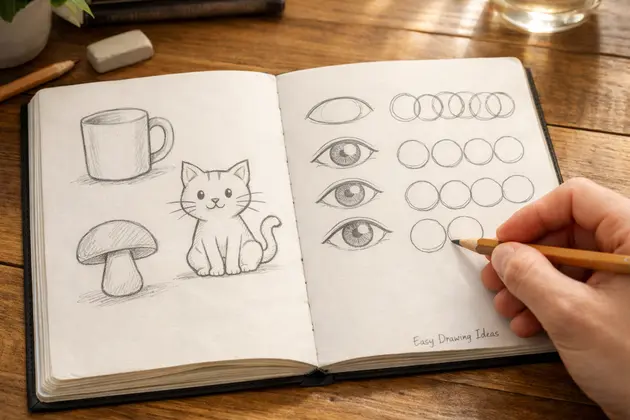
Easy Drawing Ideas for Beginners (Start Even If You Think You Can’t Draw)
Most beginners make the same mistake at the start: they pick a subject that is too complex. A face with full shading. A detailed cityscape. A realistic hand. When it does not look right, they assume they are not artistic.
The actual problem is simpler. The subject had too many variables to control at once. Start with one mug. One circle. One leaf. When the subject is simple, your full attention goes to line quality and proportion — the two things that actually build drawing skill. Complexity can come later. Control has to come first.
This guide is not just a list of things to draw.
It’s a structured path designed to:
You don’t need expensive tools. You don’t need talent. You don’t need validation. You need repetition with awareness. Let’s begin properly.
Why Easy Drawing Ideas Work (The Psychology of Progress)
Most beginners slow their progress by starting with subjects that are too demanding. A realistic portrait requires you to manage proportions, facial anatomy, shading, and expression all at once. When any one of those fails, the whole drawing suffers.
Simple subjects remove most of those variables. When you draw a coffee mug, you are only managing ellipses, proportions, and a handle. That narrow focus lets you notice exactly what is going wrong and fix it.
This is not about staying easy forever. It is about building control before adding complexity. Artists who seem to draw anything effortlessly got there by spending a lot of time on subjects that were not impressive — they were just the right level of difficulty for that stage.
The Hidden Truth About “Talent” (What Most Beginners Misunderstand)
Most people who draw well started earlier — not smarter. Some sketched through school notebooks. Some copied comic characters for years without thinking of it as practice. By the time you see their work, they have put in hundreds of hours that are completely invisible to you.
This matters because it reframes the comparison. You are not looking at natural ability. You are looking at accumulated hours. Those hours are available to you too, just starting now instead of earlier.
Drawing skill breaks down into specific trainable components: hand-eye coordination, proportion judgment, shape recognition, line control. None of these require a gift. All of them respond to repetition.
How to Start Drawing the Right Way
Before the ideas, you need structure. Because random drawing leads to random improvement. Intentional drawing leads to accelerated growth.
Step 1: Master Basic Shapes First
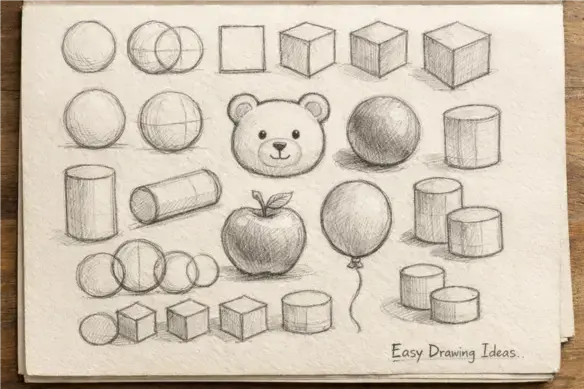
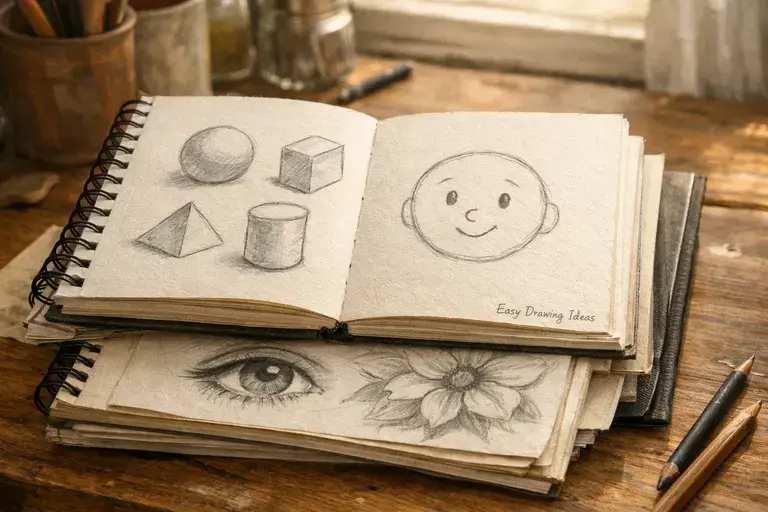
Everything complex is made of simple forms.
Circles.
Squares.
Triangles.
Rectangles.
Cylinders.
Spheres.
Draw a full page of circles. Not perfect circles. Confident circles.
Common beginner mistake:
You draw slowly to make it neat. That creates shaky lines.
Instead:
Draw lightly. Move faster than feels comfortable. Accept imperfection. Line confidence improves with speed, not hesitation.
Now transform those circles into:
This builds transformation thinking — the ability to turn simple forms into recognizable objects.
Step 2: Learn Proper Eye Placement (The Most Common Mistake)
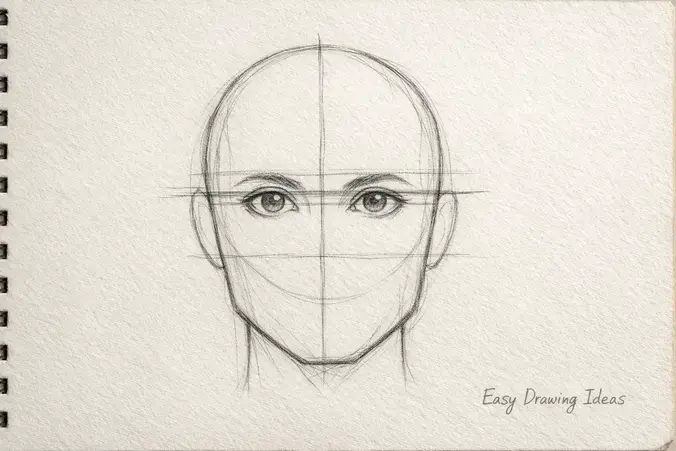
Beginners almost always place eyes too high on the head.
Why?
Because we think of eyes as being near the top. In reality, human eyes sit roughly halfway down the head. Draw a circle. Draw a horizontal line through the middle. Place eyes on that line. Even cartoon faces look more balanced this way. This single correction improves beginner portraits instantly.
Step 3: Outline Before Shading
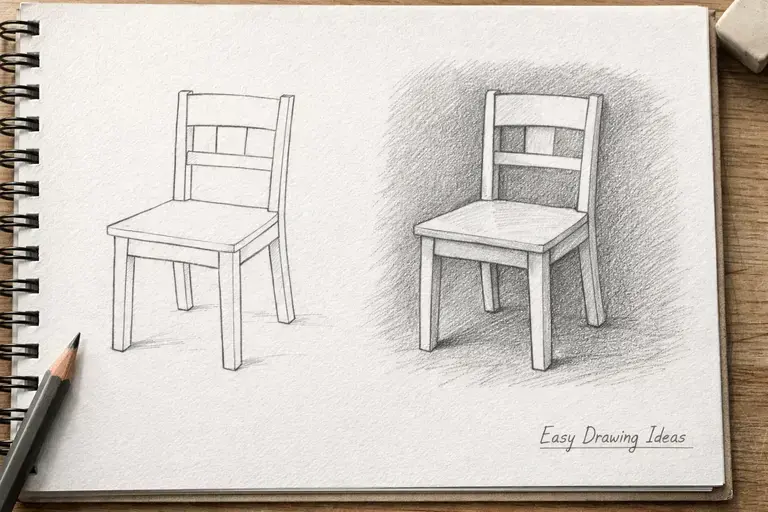
Shading is attractive. It makes art look “advanced.” But shading on weak structure creates messy results. If the proportions are wrong, shadows won’t fix it.
Focus on:
Add shading later — when the drawing stands strong on its own. Structure first. Detail second. Always.
Step 4: Draw From the Shoulder, Not Just the Wrist
Small wrist movements create stiff lines.
Try this:
For larger shapes, move your entire arm. Let the motion feel loose.
You’ll notice:
Drawing is physical. Relaxed movement equals confident lines.
Step 5: Use Reference Intelligently
Reference is not cheating. Blind copying is.
When using a reference:
After finishing, compare.
Ask:
Correction awareness accelerates improvement.
50+ Easy Drawing Ideas (With Micro-Guidance)
Choose one and start immediately. Overthinking kills momentum.
Easy Animal Drawing Ideas
Easy animal drawing ideas are perfect for beginners because animals rely heavily on curves.
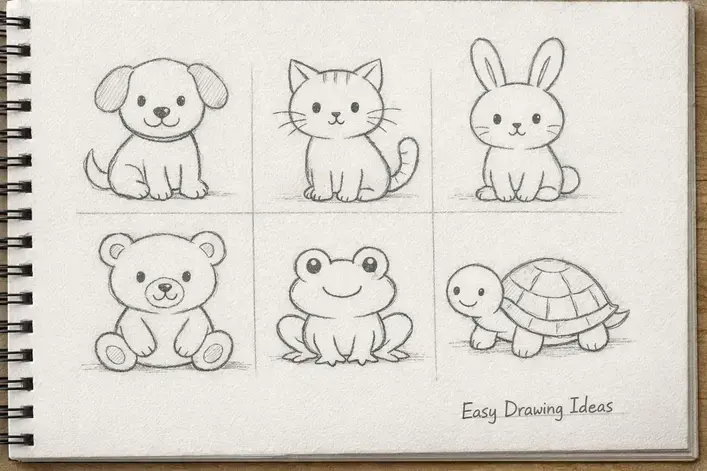
Cute and Simple Animals
Sloth
Start with a round body hanging from a branch. Add relaxed eyes for a sleepy look.
Otter
Draw an oval body floating on water. Add tiny paws holding a shell.
Meerkat
Use a tall oval body and small round head. Add tiny front paws.
Ferret
Sketch a long curved body with a playful pose.
Guinea Pig
Draw a fluffy oval body and tiny ears. Keep legs very small.
Alpaca
Use a fluffy cloud-like body and a long thin neck.
Llama
Similar to an alpaca but with a taller neck and upright ears.
Duckling
Round fluffy body with tiny webbed feet.
Squirrel with Acorn
Draw a small squirrel holding an acorn with a large fluffy tail.
Armadillo
Start with a half-oval body and add curved armor segments.
Birds and Sea Life
Seahorse
Draw a curved S-shaped body with a tiny curled tail.
Parrot
Small round body sitting on a branch with a curved beak.
Baby Bat
Draw a tiny round body with folded triangular wings.
Crab
Oval shell with two simple claws and small eyes on stalks.
Lobster
Segmented body with two curved claws.
Jellyfish
Bell-shaped top with flowing tentacles.
Starfish
Five uneven arms radiating from a center.
Clownfish
Oval fish body with simple stripe patterns.
Sea Turtle (Top View)
Draw a hexagon shell pattern and small flippers.
Flying Bird Silhouette
Two curved wings forming a soft “V”.
Tip:
For water animals, exaggerate flow in lines. Rigid lines make sea creatures look stiff.
Easy Nature Drawing Ideas
Nature builds layering skills.
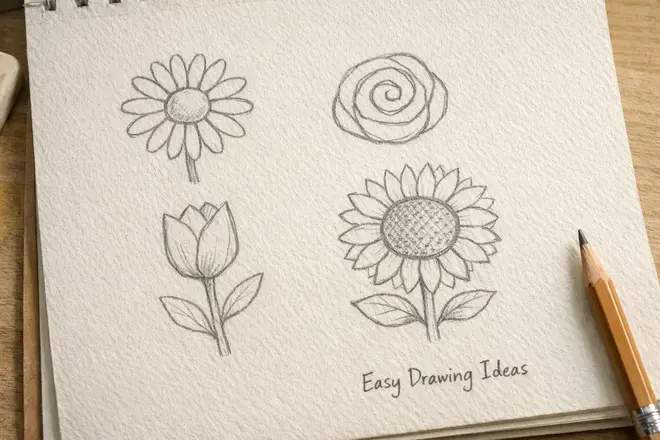
Flowers and Plants
Lavender Sprig
Draw a long stem with tiny oval flowers stacked upward.
Dandelion Puff
Small circle center with light radiating lines.
Lotus Flower
Layered petals forming a symmetrical shape.
Hanging Vine
Draw thin stems with heart-shaped leaves.
Small Cactus Trio
Three simple cactus shapes in one pot.
Landscapes
Palm Tree on a Tiny Island
Small sand mound with a curved palm trunk.
Rolling Hills Scene
Layer two or three curved hills for depth.
Simple Desert Dunes
Flowing curved lines for sand layers.
Forest Path
A narrow path disappearing between trees.
Stone Stack
Draw balanced smooth rocks on top of each other.
Pond with Lily Pads
Simple oval pond with floating pads.
Rain Cloud Scene
Round cloud with small falling raindrops.
Windy Tree
Curved trunk with leaves flowing sideways.
Night Moon Landscape
Large moon behind a simple hill silhouette.
Small Waterfall
Vertical lines falling from a rock ledge.
Easy People and Faces
Faces feel intimidating. They are not complex. They are structured.
Basic Feature Practice
Eyes
Almond shape. Iris centered. Add a light reflection dot.
Nose
Simple triangle or curved line for beginners.
Lips
Soft M-shape for upper lip. Curve for lower.
Ears
Align between eyebrow and nose line.
Practice features separately before combining.
Simple Portrait Method
Common mistake:
Making one eye larger.
Fix:
Measure visually. Compare widths using pencil as a guide.
Everyday Objects (Training Observation)
Objects are excellent for training observation, proportion, and perspective awareness.
Vintage Key
Draw a long shaft with decorative shapes at the top.
Pocket Watch
Circle watch with a small chain loop.
Lantern
Rectangular frame with a glowing light inside.
Compass
Draw a circle and add a simple north arrow.
Kite
Diamond shape with ribbon tail.
Headphones
Two circular ear cups connected by a curved band.
Plant Pot
Small pot with leaves growing upward.
Paper Airplane
Triangle folds showing the paper shape.
Stacked Notebooks
Draw slightly offset rectangles.
Desk Lamp
Cylinder base and angled cone shade.
Cute and Aesthetic Doodles
Perfect for sketchbooks and bullet journals.
Mini Polaroid Frame
Draw a tiny landscape inside.
Hanging Star Charms
Stars hanging from thin lines.
Tiny Candle
Small flame with soft smoke curves.
Heart Envelope
Envelope with a small heart seal.
Constellation Pattern
Dots connected with thin lines.
Mini Flower Vase
Simple vase with two or three stems.
Sparkle Stars
Four-point sparkle shapes.
Minimal Moon Phase Row
Draw different moon shapes in sequence.
Tiny Window Scene
Window frame with mountains outside.
Decorative Page Divider
A horizontal line with tiny leaves.
5-Minute Drawing Prompts
When motivation is low:
Short sessions maintain habits. For gesture practice, Line of Action offers free timed drawing sessions.
Powerful Skill-Building Exercises
🎯 Stuck? Get Your Instant Drawing Practice Plan
Select what you struggle with and receive a focused beginner practice task instantly.
Select a struggle above to get your practice plan.
Draw the Same Object Five Times
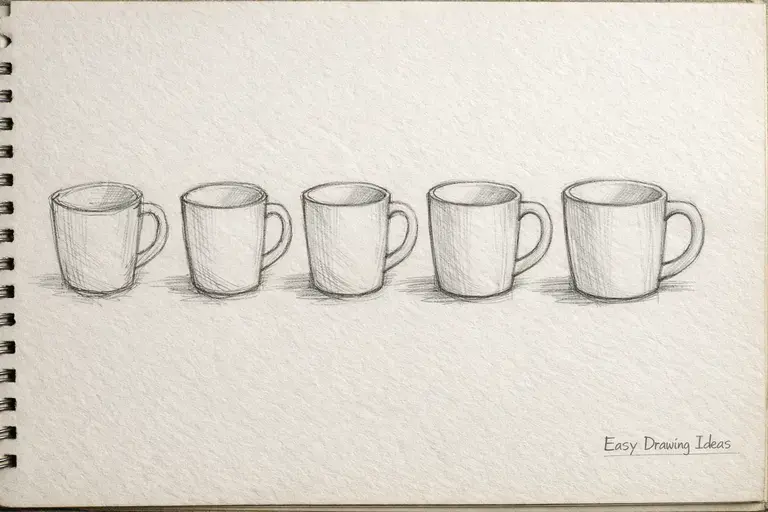
Example: A mug.
Each attempt improves:
Repetition reveals error patterns.
Memory vs Reference Test
Look at an object for one minute. Hide it. Draw from memory. Then compare.
You’ll notice:
Your brain simplifies aggressively. That awareness sharpens observation.
Negative Space Awareness
Instead of drawing the object, draw the space around it. This trains proportion recognition.
Line Confidence Drill
Fill a page with straight lines. No ruler. One motion per line. Accuracy improves with mileage.
Common Beginner Mistakes (And Why They Happen)
Understanding mistakes removes shame.
1. Shaky Lines
Cause: Drawing too slowly.
Fix: Move faster. Light pressure.
2. Uneven Eyes
Cause: No guidelines.
Fix: Always sketch horizontal alignment.
3. Flat Drawings
Cause: No overlapping forms.
Fix: Slightly overlap elements for depth.
4. Over-Shading
Cause: Trying to “fix” structure.
Fix: Correct shape first.
5. Giving Up Too Early
Cause: Expecting fast perfection.
Fix: Measure improvement monthly, not daily.
How to Stay Consistent (Even When Motivation Fades)
Consistency in drawing comes down to making the sessions small enough that skipping feels unnecessary. If you tell yourself you need an hour to practice, you will skip on busy days. If the goal is one page or ten minutes, the barrier is low enough that you actually do it.
Keep your sketchbook and pencil on your desk, not in a drawer. Visible tools get used. Hidden tools get forgotten. When you do miss a day, do not try to compensate by doing double the next day. Just pick up where you left off. The goal is a long streak of small sessions, not occasional marathon drawing days.
My Honest Advice for Beginners
You do not need a drawing tablet to start. You do not need special paper. A regular pencil and printer paper are enough for the first few months of practice.
The one thing that actually separates people who improve from people who stay stuck is simple: they keep drawing after the bad sessions. Not every sketch will look good. Some days your lines will feel worse than last week. That is normal and it does not mean you are going backward.
Buy a cheap sketchbook. Date every drawing. Do not tear pages out. After 60 days, flip back to page one. The difference will be visible and that visible difference is more motivating than any advice.
What Improvement Actually Feels Like
Improvement in drawing is gradual and easy to miss day to day. The clearest sign is not that your drawings look “good” — it is that specific problems stop repeating. Early on, you might draw eyes in the wrong position every single time. Then one day you catch the mistake before finishing. Then you stop making it. That is what progress looks like — errors becoming less frequent, not drawings becoming suddenly impressive.
Another sign: you spend less time second-guessing where to put the next line. Decisions that used to feel uncertain start feeling automatic. Proportions that required measuring start feeling intuitive. These shifts happen slowly, but they are real.
Frequently Asked Questions About Easy Drawing Ideas
Final Thoughts on Easy Drawing Ideas
Drawing is a skill with a learning curve that flattens out faster than most people expect, provided the practice is regular.
The first few weeks feel slow because everything requires conscious effort — where to place the eye, how wide to make the head, how much pressure to use on the pencil. That conscious effort is the work. It does not stay hard forever.
Keep a dated sketchbook. Draw something small every day. Look back every month. The sketchbook does not lie — and after a few months, it will show you clearly that the practice is working, even on the days when it did not feel like it.